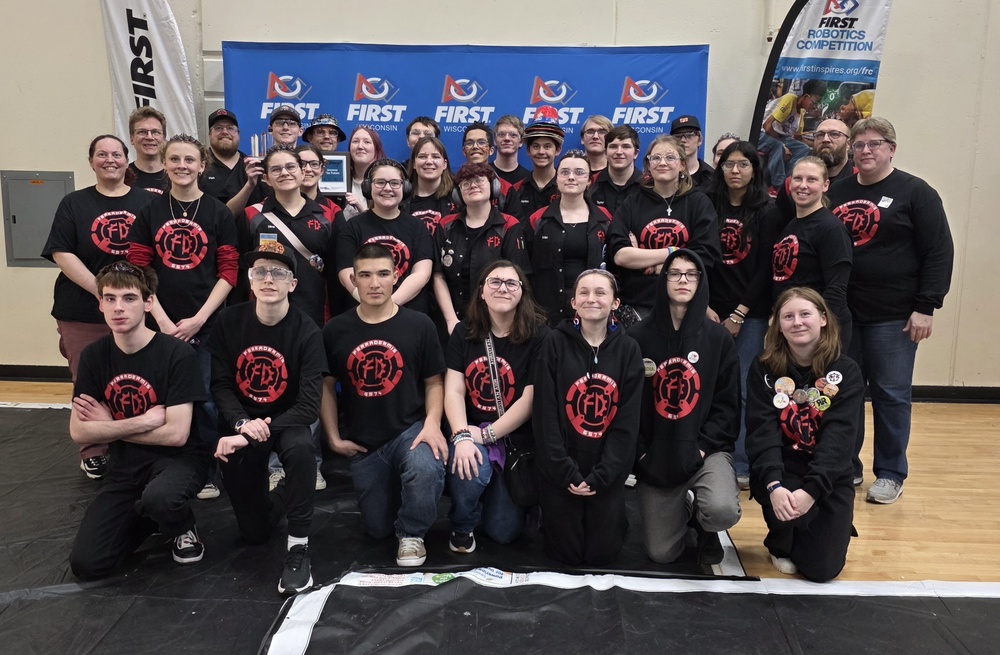
From Friday, March 6 through Sunday, March 8, 26 members of Ferradermis put their new 2026 robot CEO (Chief Excavation Officer) to the test on the field at Lakeland University. Lakeland played host to 33 Wisconsin teams for the first ever Wisconsin District Event. Over the course of the last year, Wisconsin has transitioned from a “regional” model of competition to a “district” model of competition. In essence, this means that Wisconsin FIRST Robotics Competition (FRC) Teams will now play in-state to a State Championship with teams earning a berth to the Houston World Championships via their performance at State. This transition was possible because of the growing popularity of the program in the state; Wisconsin is now home to 72 FRC teams.
The 2026 FRC game, like the FLL and FTC games from the fall, is based on an archeology theme. In the case of the FRC game, Rebuilt, the game brings back field elements and game pieces reminiscent of games played over the last 25 years of FIRST. The only game piece this year is a bright yellow solid foam ball called fuel, just like the yellow whiffle balls from Ferradermis’ rookie year in 2017. There are 504 pieces of fuel on the field at any one time, leading to complete chaos and the likelihood that robots will go “fuel surfing” by ending up entirely beached on top of multiple pieces of fuel. Alliance partners often have to give each other’s robot a nudge to get their robots off the top of the fuel field.
The performance of CEO improved greatly over the course of the event as the pit crew including sophomore Jayden Kehrer, lead programmer Ace Hudec, and mentor Quinn McKenzie continued to make slight adjustments to electrical, mechanical, and coding aspects of the robot between matches. The robot relies heavily on computer vision through use of a Limelight camera to spot April Tags (like QR codes) on the field to automatically calculate the angle of its shots.
The drive team, consisting of Driver Mason Genung, Operator Erison Dreksler, Human Player Vivian Harris, Technician Owen Taylor, and Drive Coach Mark Zimmermann, led the robot onto the field for 2 practice matches and each of its 12 qualification matches. District events are designed to be smaller and run on a compacted schedule, leaving much less time between matches. At the end of qualifications, the Ferradermis robot ranked #13.
The scouting team including Emilie Bruns, Mily Zeferino-Hernandez, and Preston Miller worked diligently in the stands throughout qualifications with their scouting alliance partners Red Raider Robotics from Sheboygan North and CORE from Waukesha. The trio of teams had decided to band together to test out a new scouting app. Thank you to mentor Kevin Housel for helping Head Scouts Rae Breisath, Georgia Esch, and Zoey Ambrose learn the ins and outs of the new system. Ferradermis students cycled through hour-long scouting shifts, with each student following a particular robot in a match and entering data into the app. Students also paired up to do pit scouting, interviewing other teams in the pits about the capabilities of their robots.
Alliance selections for the playoffs took place immediately after the last qualification match, and, armed with their scouting data, Ferradermis was represented on the field by Breisath, Ambrose, and Genung. The team was invited to join the #8 seeded alliance with the RoboCats from River Falls and Saber Robotics from Franklin. The alliance was defeated in the double-elimination playoff bracket first by the eventual champion alliance led by BadgerBots from Middleton and then by the #4 seed led by Ripon Robotics.
On Saturday, the Impact Presentation Team of Al Nelson, Sam Raupp, and Cooper Housel met with a panel of judges to share a 7-minute presentation and do a 5-minute Q & A session. These students outlined all of the work that Ferradermis does to support younger students in STEM and to help create other FRC teams in the state, highlighting the over 1,500 hours of outreach that team members have logged just since June.
Also on Saturday, team FIRST Leadership Award nominees Raupp and Harris sat for their interviews with a panel of judges. The Leadership Award is the only individual student award in FIRST, and candidates need to learn to highlight their personal contributions rather than talk about what the team has accomplished.
On Sunday morning, after the mentor parade, Zimmermann was welcomed to the field as the team’s Woodie Flowers Award nominee for outstanding mentor. As is FIRST tradition, previous Woodie Flowers Finalist Award Winners, including Ferradermis Advisor Laura Masbruch, created a high-five line for the nominees. This year’s winner for the state will be announced at the State Championship event.
During Sunday’s opening ceremonies, 13 team members including Chacha Binagi, Asher Downs, and Colby Long volunteered to be part of the FIRST Wisconsin Team Choir to sing the national anthem. Also helping where they could and filling volunteer roles at the event were Alex Fletcher, Charlotte Trautman, and Frankie DiFiore who helped with field reset during Friday night’s practice matches. On Sunday, the tournament host again reached out to the team for volunteers and Trautman, DiFiore, and Carson Miller stepped up for a full day of field reset duties while Paxton Wilson and Julian Rennells helped queue robots for matches. Elora Wildermuth-Breitzman volunteered as an ambassador, giving tours to VIPs visiting the event. Housel served as the team’s media representative. Thank you to mentors Kat Dunham, Tori Breisath, and Matt Doherty for volunteering their time to help support students in the stands and in the pit. We also loved seeing Ferradermis alumni now working with other teams: Reilly Aschenbrener with Graffiti from Greendale, Jacob Lee and Rosie Aschenbrener with the Mukwonago Bears, and Peter Portwine with UPS from Milwaukee.
Ferradermis is currently celebrating its 10th anniversary season in FIRST, and students planned some celebrations to highlight the milestone. After researching and finding that diamonds are a representation of the 10th anniversary, team members ordered tiaras to wear at the event. However, they wanted to share the fun with the other teams at the event marking the same milestone. The team delivered tiaras to Red Raider, Warriorbots from Muskego, and FE Freedom Engineers along with 10th anniversary cards signed by the team. In addition, the team created a series of 3D printed pit awards to be given to other teams. Teams were recognized for forging a friendship with iron-skinned Ferradermis (an award in the shape of an anvil), being the most helpful, having the best mascot, and putting safety first, among other things.
Throughout the event, students in the pits need to be prepared to speak with roving pairs of judges that will stop by and ask questions about the team and the robot. Wildermuth-Breitzman and Safety Captain Nina Heim remained in the pit for all three days of the event, ready to discuss whatever questions the judges had. The judges were particularly interested in speaking with Hudec about the team’s control system. Under the guidance of programming mentor Andy McKenzie, the programmers have implemented a custom button board each of the last two seasons. As a result of these conversations, the team was announced as the winners of the Innovation in Control Award sponsored by nVent. This award recognizes teams with unique and effective control systems—software, electrical, or mechanical—that enhance machine performance.
Ferradermis will play in their second district event in La Crosse from April 2 – 4. The Seven Rivers District Event in La Crosse will be the fourth and final qualifying event for Wisconsin teams. All teams will play in two of the four competitions. State qualification berths will be finalized after the La Crosse event.
On the way to the event, the team took time to tour the Kohler Design Center and the John Michael Kohler Arts Center.
For more photos from the event, visit the teams social media at facebook.com/ferradermis.